











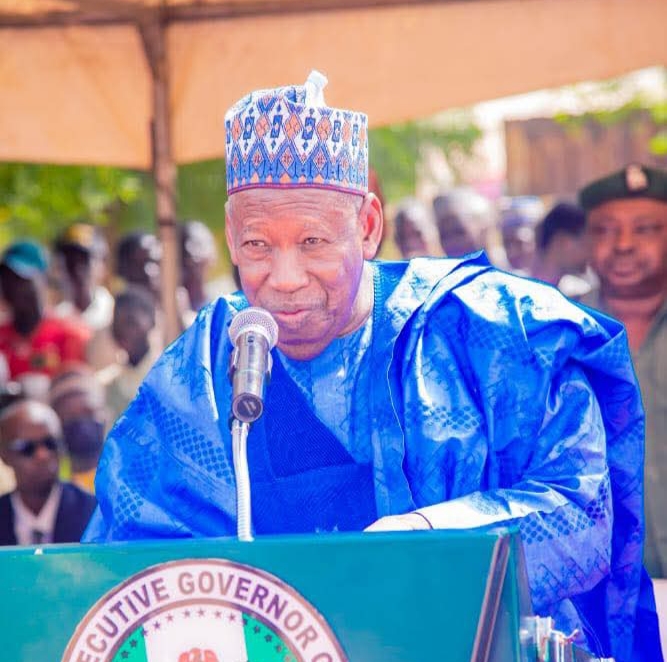
Dr. Abdullahi Umar Ganduje has resigned from his position as national chairman of the All Progressives Congress (APC), bringing an abrupt end to a tenure marked by internal party friction and legal wrangling.
Ganduje, who governed Kano State from 2015 to 2023, reportedly stepped down with immediate effect.
Multiple sources confirmed the development to TheCable, with indications that President Bola Tinubu has virtually convinced Rabiu Musa Kwankwaso—Ganduje’s long-time political foe—to join the APC.
A senior official at the party’s national secretariat, who preferred anonymity, confirmed the news off the record.
“Between me and you, it is true, but I can’t confirm officially — and please don’t quote me,” the source said.
Another insider disclosed that one of the APC’s national vice chairmen will assume the role in an acting capacity until a national convention is held in December.
Ganduje’s resignation comes despite a recent flurry of public appearances, raising questions about earlier claims of health issues.
Earlier in the day, he led the APC National Working Committee on a condolence visit to Niger State Governor Umaru Bago at the Abuja liaison office.
The delegation sympathized over the Mokwa flood disaster, which has claimed over 200 lives, and a rise in bandit attacks in Mariga Local Government Area.
Just a day earlier, he had also attended a high-level meeting at the Independent National Electoral Commission (INEC) headquarters in Abuja alongside the party’s national secretary, Surajudeen Ajibola Basiru.
His tenure as national chairman began in August 2023 after he was appointed by the APC’s National Executive Committee (NEC).
But his leadership was quickly engulfed in controversy—from lingering legal challenges to deepening divisions within the Kano chapter of the party and internal pushbacks from other APC power brokers.
Now, all eyes turn to the unfolding political calculus: Kwankwaso, a former Kano governor and presidential candidate of the New Nigeria Peoples Party (NNPP) in 2023, may soon be on course for a return to the APC, potentially reshaping the northern political map ahead of the 2027 elections.