



















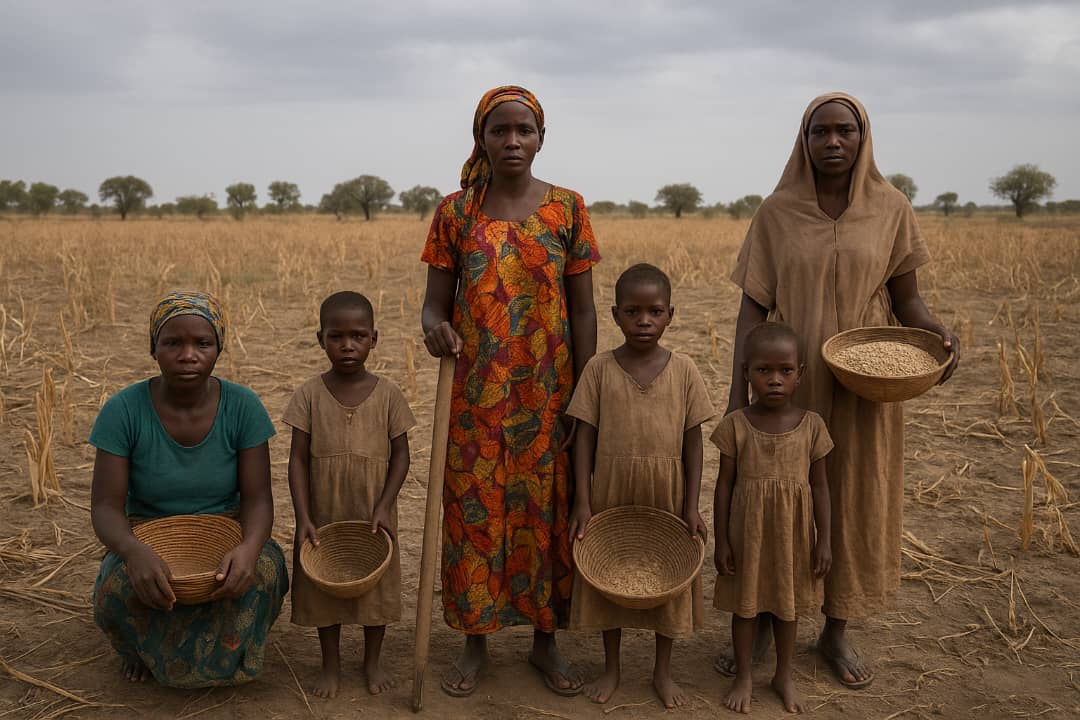
About 650,730 people in Borno, Sokoto, and Zamfara States may face crisis-level or worse food insecurity between June and August 2026.
The figure came from the October 2025 Cadre Harmonisé Food and Nutrition Insecurity Analysis released on Friday in Abuja.
The analysis was jointly presented by the Food and Agriculture Organization and the Federal Ministry of Agriculture and Food Security.
The report warns that Nigeria could experience one of its most severe hunger crises if urgent measures are not taken.
It said about 34.7 million Nigerians, including internally displaced persons, could face acute food insecurity by June 2026.
Already, 27.2 million people are living under crisis or worse hunger conditions across 27 states and the Federal Capital Territory.
In Borno, six local government areas are projected to experience emergency levels of food insecurity.
Food situations in Adamawa and Yobe States are also expected to deteriorate further.
The report said more than half of Nigerian households are managing acceptable food consumption only by reducing meal quality or borrowing to buy food.
Dr. Marcus Ogunbiyi, permanent secretary at the Federal Ministry of Agriculture and Rural Development, reaffirmed the government’s commitment to strengthening food systems and resilience.
‘Together, let us continue to strengthen frameworks that will support Nigerians towards achieving zero hunger and food sufficiency,’ Ogunbiyi said.
FAO representative in Nigeria, Dr. Hussein Gadain, identified insecurity, insurgency, banditry, flooding, and climate shocks as the main factors driving food insecurity.
He said the rising cost of farm inputs, including fertilizer, seeds, and energy, continues to threaten production despite slight drops in food prices.
‘This October cycle covered 27 states and the FCT, an increase from 26 in March. However, nine states remain outside the Cadre Harmonisé process,’ Gadain said.
He commended Ekiti State for joining and supporting data collection, calling it an example of state-level commitment to tackling hunger.
‘Flooding and other climate events have devastated croplands, compounding risks for affected communities. The Cadre Harmonisé analysis remains our most relevant early warning tool,’ he added.
The analysis guides humanitarian programming and development planning at both national and state levels.
Experts recommended more humanitarian support, investment in climate-smart agriculture, and integration of Cadre Harmonisé findings into early policy action.
The Cadre Harmonisé is a biannual, government-led assessment supported by the FAO, other UN agencies, and partner organizations.
It provides a unified system for monitoring hunger, identifying vulnerable populations, and guiding timely interventions across Nigeria.