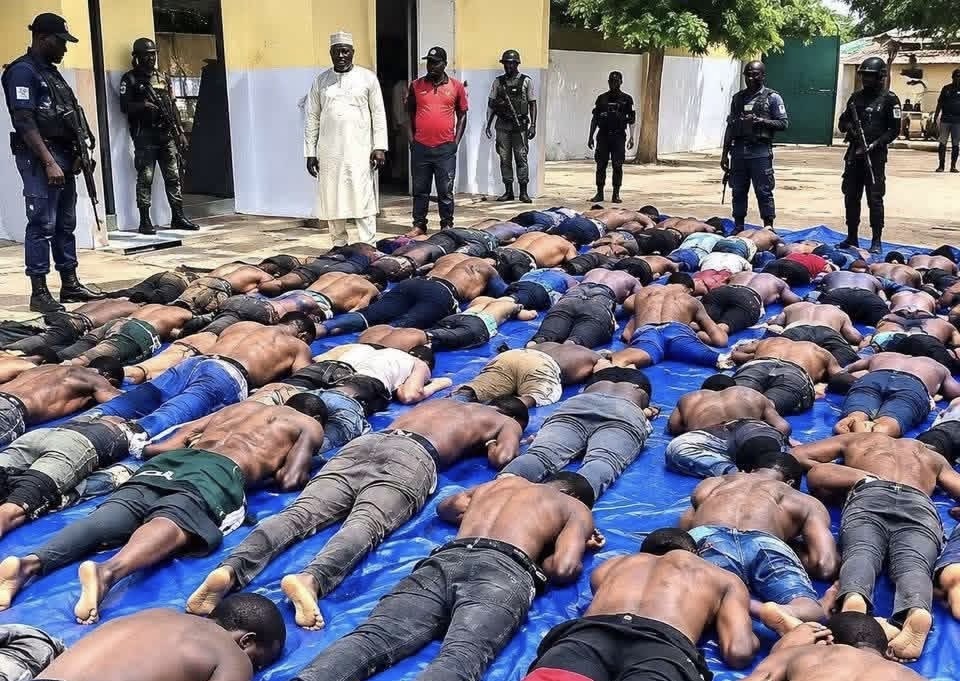
















President Bola Tinubu has declared that individuals financing terrorism and aiding the killing and abduction of innocent Nigerians will face severe consequences.
He also handed a final warning to bandits, kidnappers and terrorism sponsors to either surrender or confront the full might of the Nigerian government, revealing that more than 13,000 terrorists had been eliminated within the last year.
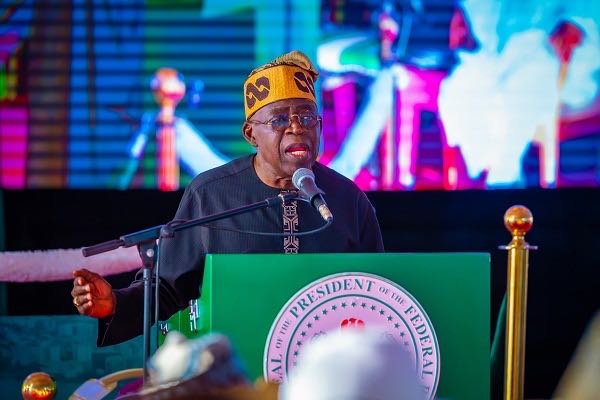
Tinubu issued the warning during his nationwide broadcast marking Nigeria’s 27th uninterrupted Democracy Day celebration and his fourth observance of the event since assuming office in 2023.
According to him, although terror-related fatalities have reduced by 81 per cent since 2015, the continued detention of schoolchildren abducted in Oyo and Borno states cast a shadow over this year’s Democracy Day commemoration.
He declared, “To bandits, kidnappers, and sponsors of terror: Surrender or face the full force of the Nigerian State.
“These windows of surrender will not remain open forever. No mercy will be shown to those who trade in the blood of Nigerians.”
The President stated that his administration had progressed from receiving training support from foreign partners to carrying out targeted military operations against terrorists.
“We have moved from training with our allies, the United States, France and other European countries, to precision targeting.
“In Arege, Borno State, we degraded ISWAP’s command centre.
Terror-related deaths are down by 81 per cent since 2015.
“Over 13,000 terrorists have been neutralised in the past year,” he stated.
Tinubu noted that while military action remained a key strategy, avenues for rehabilitation were still available to repentant fighters.
“Over 124,000 fighters and dependents have laid down their arms since 2023 through Operation Safe Corridor,” he said.
He explained that the N5.41tn earmarked for security and defence in the 2026 budget demonstrated the government’s determination to end the terrorism crisis that has persisted since 2009.
Apart from the budgetary commitment, the President disclosed that approval had been granted for the recruitment of over 50,000 additional police officers alongside thousands of military personnel to bridge the security manpower gap in a nation of more than 230 million people.
Tinubu admitted that despite the country’s celebration of 27 years of uninterrupted democratic rule, the ongoing captivity of pupils and teachers abducted in Oyo and Borno states, now entering its fourth week, had dampened the national mood.
“Though this year’s mood is dampened by the abduction of our children in Oyo and Borno, we remain hopeful for their safe return. Democracy without security is a mirage.
“That is why this administration declared a security emergency and approved the recruitment of more than 50,000 new police officers and thousands of military recruits.
“Our 2026 budget commits N5.41tn, our largest ever, to defence and security. Our administration is ever ready to do much more to secure our people,” he stated.
The President appealed to Nigerians to remain united in confronting insecurity, stressing that criminal activities should not be viewed through ethnic or religious lenses.
“At a time like this, let us not assign blame or point fingers. Crime has no ethnicity.
“We must stand united and be assured that the enemies of our nation shall soon be history.
“We will triumph over terror and continue to build a more prosperous nation,” he declared.
Addressing the recurring electricity challenges experienced over recent years, Tinubu outlined the condition of the power sector before his administration came into office and the measures taken to improve it.
He said that by 2023, the sector suffered from persistent generation deficits, unstable gas supply and weak transmission infrastructure that was incapable of wheeling available electricity. Distribution companies, he added, were weighed down by substantial losses and a metering shortfall exceeding four million.
“The result was a sector that generated less than the 13,500 megawatts installed capacity, a sector that transmitted less than it generated, distributed less than it transmitted, and collected revenue far below what it needed to sustain itself,” he added.
Tinubu said that to reverse the situation, he signed the Electricity Act, empowering states to generate, transmit and distribute electricity, authorised the Presidential Power Sector Task Force to raise a N4tn bond for verified legacy liabilities and expanded rural electrification initiatives through support from international development partners.
He explained, “To address the problems besetting the sector, I signed the Electricity Act, which grants states authority to generate, transmit, and distribute power.
“The Presidential Power Sector Task Force is working hard to reduce the metering deficit. It has also been authorised to raise N4tn bond to settle verified legacy debts.
“The Rural Electrification Agency, supported by the World Bank and the African Development Bank, has deployed off-grid and mini-grid power to underserved communities, universities, markets, and hospitals.
“Electricity is a democratic dividend we owe every Nigerian. We intend to deliver it.”
Speaking on the wider economy, Tinubu stated that federal revenue had increased, allowing states and local governments to access more resources, while fiscal accountability had improved and investor confidence had strengthened across key sectors including agriculture, energy, manufacturing, technology, mining, transport and the creative economy.
He said non-oil exports expanded by 21 per cent in the previous year, more than 1,000 SMEs had obtained export certification, and the National Agricultural Development Fund was implementing a programme to deploy 10,000 tractors over five years.
Nevertheless, he admitted that many Nigerians were still experiencing economic difficulties.
“Yet, many Nigerians still face economic hardship. We remain focused on reducing inflation, expanding food production, creating jobs, improving living standards, rebuilding confidence in our economy, and creating conditions for sustainable prosperity.
“We are moving from uncertainty to stability. The next phase is about accelerating growth and ensuring the benefits are felt in every home, every community, and every region. We believe that Democracy must be felt in the pocket,” he stated.