



















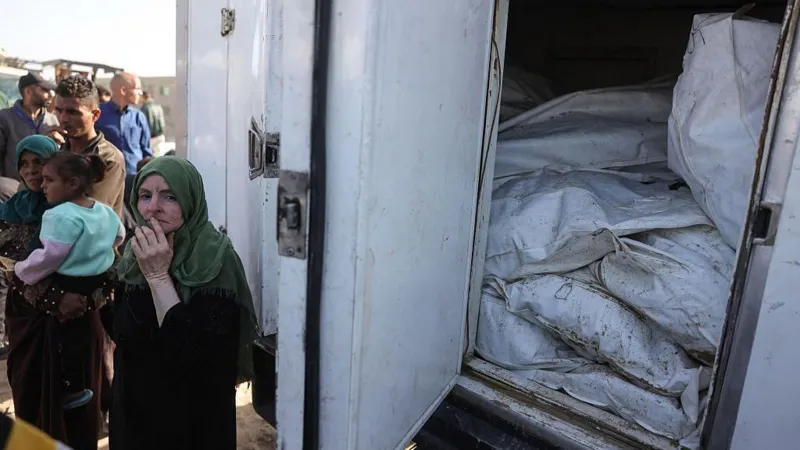
In Gaza’s Nasser Hospital, a small team of forensic doctors is working under near-impossible conditions to identify and examine the bodies of Palestinians returned by Israel.
The bodies — 195 so far — were exchanged for 11 Israeli hostages as part of a ceasefire agreement brokered by former U.S. President Donald Trump.
Many of the bodies arrived in advanced stages of decomposition, some dressed in civilian clothes, others naked or wearing only underwear.
Several had their wrists tied behind their backs, and some appeared to have blindfolds or rope marks around their necks.
Dr. Ahmed Dheir, who heads the hospital’s forensic unit, said the team lacked both DNA testing facilities and adequate cold storage.
“The situation is extremely challenging,” he explained. “Once the bodies start to thaw, decomposition begins immediately. We have to document their state quickly before evidence is lost.”
Doctors report “signs of torture”
Images reviewed by the BBC show clear evidence of restraint marks and possible physical abuse.
Dr. Alaa al-Astal, another forensic expert at Nasser Hospital, said several of the recovered bodies displayed “signs of torture,” including deep grooves around wrists and ankles caused by tight bindings.
“There were horrific cases where blood circulation was cut off,” he said. “Some bodies had deep marks around the eyes where blindfolds were tied.”
He added that a number of corpses arrived with cloths around their necks — one with a groove suggesting possible strangulation, though confirmation would require an autopsy.
Officials from Gaza’s forensic committee also reported stab wounds and bruises on some bodies.
However, without post-mortems, experts say it remains difficult to draw definitive conclusions about whether the injuries occurred before or after death.
Israel denies mistreatment claims
The Israeli military said it “operates strictly within international law” and described all the returned bodies as “combatants within the Gaza Strip.”
The army denied binding the bodies before release.
Forensic specialists outside the region said the limited evidence raises troubling questions.
“What’s happening in Gaza is an international forensic emergency,” said Dr. Michael Pollanen of the University of Toronto.
“Only full autopsies can determine the truth behind these deaths.”
Yet Gaza’s doctors insist the evidence of abuse is overwhelming.
“When someone is found naked, tied behind their back, and with visible marks of restraint, that suggests torture,” said Dr. Dheir. “This is a violation of international law.”
Unidentified and unclaimed
Complicating matters further, the Israeli side reportedly sent back identification for only six of the 195 bodies — five of which turned out to be wrong.
Gaza’s forensic officials say Israel also withheld key data such as DNA matches, dates of death, and detention records.
“Since these bodies were held by Israeli authorities, they must have detailed information,” Dr. Dheir said. “But nothing has been shared with us through the Red Cross.”
As Gaza’s morgues fill beyond capacity, unidentified bodies are being buried in mass graves after examination.
“Families deserve to know who these people were,” said forensic official Sameh Yassin Hamad.
“Without proper data and transparency, the truth remains buried with them.”