
















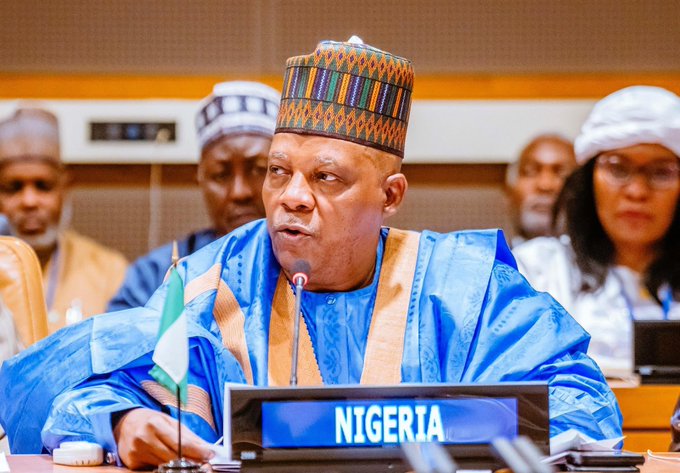
Vice President Kashim Shettima has said that Nigeria is greater than any trade union or individual interest.
He made the statement on Monday in Abuja during the 31st Nigerian Economic Summit (NES31) themed “The Reform Imperative: Building a Prosperous and Inclusive Nigeria by 2030.”
Shettima stressed that the Dangote Refinery must be safeguarded at all costs, describing it as a $20 billion national asset that deserves protection and support.
His remarks followed an ongoing industrial dispute between the Petroleum and Natural Gas Senior Staff Association of Nigeria (PENGASSAN) and the 650,000-barrel-per-day Dangote Refinery.
Shettima: “Dangote is an institution, not just an individual”
The Vice President praised Aliko Dangote’s contribution to Nigeria’s economy, saying his investment choices reflect deep patriotism.
“Aliko Dangote is not an individual; he’s an institution and a leading light in Nigeria’s economic parliament,” Shettima said.
He argued that if Dangote had invested his $10bn in foreign tech giants like Microsoft or Amazon, his fortune could have grown several times over.
“But he chose to invest in his country, and we owe it to future generations to protect and promote that decision,” he added.
Shettima urged both labour unions and the private sector to act responsibly in managing industrial relations, warning against actions that could harm Nigeria’s growing economic stability.
NESG chairman warns against investor uncertainty
Earlier, the Chairman of the Nigerian Economic Summit Group (NESG), Olaniyi Yusuf, said that Nigeria’s weak foreign direct investment reflects investors’ cautious attitude.
He warned that how the country treats local investors will shape global perception of its economic environment.
Yusuf stressed that clear policies, investor protection, and transparent systems for resolving disputes are essential to rebuild trust and confidence in the economy.
“How we treat domestic investors will provide the right signals for foreign investors,” he said.
He added that while fiscal indicators have shown improvement, the economy still faces high inflation, rising debt-service costs, and low investor confidence — challenges that must be addressed through consistent and credible economic reforms.