
















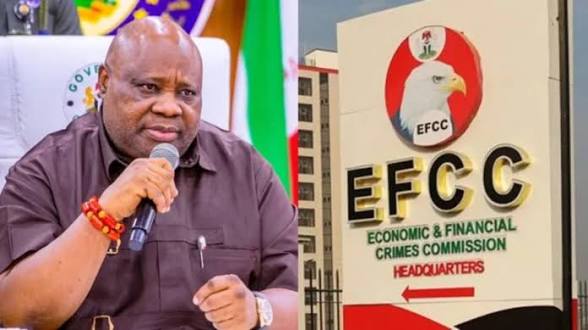
The Economic and Financial Crimes Commission has defended its decision to place a restriction on an Osun State Government account, saying the action was backed by provisions of the law.
The commission’s Director of Public Affairs, Wilson Uwujaren, said the measure did not require a prior court order, contrary to the position of the state government and the Nigerian Bar Association.
Uwujaren, speaking during an interview on Arise Television on Thursday, said the commission acted after detecting what it considered suspicious transactions on the account over the past week.
“As we indicated in the statement released by the Commission, we took that step to preserve the account of the Osun State Government.
“We observed in the past one week that activities on that account looked suspicious, and based on the mandate of the Commission, we took the step of placing a restriction on that account to preserve it,” he said.
He clarified that the commission’s action affected only one account and should not be interpreted as a complete freeze on the state government’s finances.
“That restriction order does not mean that all the accounts of Osun State have been frozen. No. It is just a targeted restriction on one account of the Osun State Government,” he said.
Uwujaren stated that the commission noticed large transfers from the account to several corporate entities within a short period, which led to the restriction.
“The essence, like I said, is just to preserve that account because we observed suspicious activities on that account in terms of the transfer of funds to a number of entities within one week.
“So we had to take that decision to place a restriction on that account, not minding the fact that there is an election process in place,” he said.
He added that the commission could not ignore the transactions, saying failure to act could have attracted criticism from the public.
“We have the responsibility under the law to do so because if we don’t take that step and, for instance, funds are looted from the account of the Osun State Government, I’m sure the Nigerian public will also ask, ‘Where was the EFCC when those funds were being moved?’” he said.
Uwujaren maintained that the state government still had access to other accounts and would not be prevented from carrying out its functions.
“It does not stop the Osun State Government from running the government of the state because they have access to other funds in the other accounts that they have.
“In any case, the payment of salaries and other expenditures by the state government happens just once in a month. What we have done is not a blanket freezing of the account.
“It’s just a targeted freezing. Once we are satisfied that activities on that account are no longer suspicious, it will be lifted,” he said.
On the legality of the restriction, Uwujaren said the commission’s authority to impose a temporary freeze was provided for under existing laws.
“A number of people have asked whether the Commission has the power to do so under the law. I can assure you that we have the power to place a temporary restriction on an account.
“Section 34 of the EFCC Act and Section 7, Subsection 6 of the Money Laundering (Prohibition) Act 2022 give us that authority to take that step,” he said.
He further explained that the temporary restriction could remain in place for up to 72 hours before the commission would need to seek a court order if necessary.
“The restriction order can last within 72 hours before we can come with a court order if we need to provide a court order,” he said.
The commission had earlier disclosed that it had been investigating the Osun State Government since March 2026 over the alleged mismanagement of about N11bn from Ecology Funds, Intervention Funds and Federation Account Allocation Committee allocations, adding that some state officials, including the Accountant General, had already been interrogated.
Uwujaren’s defence of the commission’s legal powers came after Osun State Governor, Ademola Adeleke, asked EFCC Chairman Ola Olukoyede to explain the restriction, which he described as unlawful.
The state Attorney General, Oluwole Jimi-Bada (SAN), had argued that although the EFCC could investigate government accounts, it had no power to freeze them without first obtaining a court order, and he had been directed to challenge the action before the Federal High Court in Osogbo.