















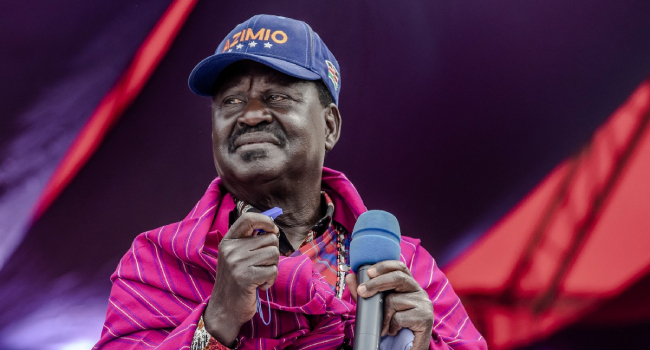
Raila Amolo Odinga, one of Kenya’s most influential and polarising political figures, has died at the age of 80 while on a trip to India, police confirmed on Wednesday.
He was receiving treatment at an Ayurvedic health clinic at the time of his passing.
Odinga, often referred to as Kenya’s perennial opposition leader, dedicated much of his life to the fight for democracy.
Despite being imprisoned for eight years under the rule of former president Daniel arap Moi and contesting five presidential elections, he never fulfilled his ambition of leading the country.
Born on January 7, 1945, into one of Kenya’s most prominent political families, Odinga carved out his reputation as a fiery reformist and tireless critic of authoritarianism.
He frequently clashed with the establishment, even as he remained a central figure in national politics for decades.
Years of struggle and political turbulence
A member of the Luo ethnic group, Odinga first entered parliament in 1992 and made his first presidential bid in 1997.
His subsequent attempts in 2007, 2013, 2017, and 2022 all ended in defeat, with Odinga repeatedly alleging electoral malpractice.
The disputed 2007 election triggered one of Kenya’s darkest chapters — widespread ethnic violence that claimed more than 1,100 lives.
To quell the crisis, Odinga agreed to serve as prime minister under a power-sharing deal, a position that was later scrapped in the 2010 constitution.
In 2018, he made headlines again when he reconciled with then-President Uhuru Kenyatta after years of political rivalry. The unexpected “handshake” between the two leaders marked a turning point in Kenya’s political landscape and symbolised a rare moment of unity.
A complex and divisive legacy
After losing the 2022 presidential election to William Ruto, Odinga again surprised many by forming a cooperation pact with his former rival in 2025 — a move that effectively dissolved any formal opposition in Kenya.
Supporters hailed him as a social reformer who championed equality and democracy, while critics accused him of exploiting ethnic divisions and being unwilling to relinquish political ambition.
Charismatic yet uncompromising, Odinga was known for his fiery speeches and his trademark defiance in the face of defeat.
Despite health challenges in his later years, he continued to command attention. His love of reggae music — especially Lucky Dube’s “Nobody Can Stop Reggae” — became symbolic of his unbreakable spirit and campaign slogan in his later political life.
Personal life and enduring influence
Educated as an engineer in former East Germany, Odinga named his late son Fidel after the Cuban revolutionary Fidel Castro, reflecting his leftist ideals.
Although not among Kenya’s wealthiest politicians, he held significant business interests, particularly in the energy sector.
He was married to Ida Odinga for nearly 50 years and is survived by her, three children, and five grandchildren.
A devout Christian who was rebaptised in 2009, Odinga often infused his political message with biblical imagery, famously promising to lead Kenyans to “Canaan,” a metaphorical promised land of justice and prosperity.