
















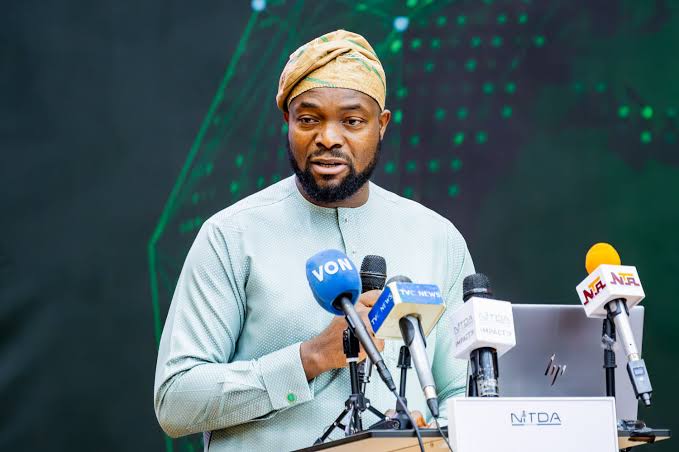
The Minister of Communications, Innovation and Digital Economy, Bosun Tijani, has declared that Nigeria has become the digital powerhouse of West Africa, stressing that the country’s increasing strength in digital infrastructure, artificial intelligence and cybersecurity should form an important pillar of its foreign policy.
Tijani made the remarks on Tuesday during the Second Seminar on Anticipatory, Cyber and Digital Diplomacy organised by the Ministry of Foreign Affairs in Abuja. The seminar, themed “From Awareness to Activation: Operationalising AI, Cyber and Digital Statecraft for Nigeria’s Foreign Policy,” brought together policymakers, diplomats and technology experts to examine Nigeria’s digital future.
The minister said diplomacy was no longer shaped only by a nation’s size, economic strength or military power, but was increasingly being influenced by digital capacity.
“I think all of us can testify to the fact that digital is now a major part of our lives in everything we do, and that’s the case for nations as well. So diplomacy in itself is shifting away from just how big your country is, the size of your economy or defence. It’s coming towards digital,” he said.
Tijani noted that Nigeria is uniquely positioned to drive digital transformation in the region, pointing out that it is the only West African country with its own communications satellites and the largest number of subsea internet cables.
“We’re the only country in the West African region with its own communication satellites; we’re the only country in the West African region with the highest number of subsea cables,” he said.
According to him, Nigeria has also evolved into the data hub of West Africa, making it strategically significant to global technology companies and neighbouring countries.
“The implication of this is that we’re a powerful nation. We’ve always been, but in the digital space, we’re a powerful nation,” he added.
The minister disclosed that the Federal Government is reinforcing the country’s cybersecurity framework through a new Ministerial Advisory Council on Cybersecurity, which will bring together government and private sector stakeholders to share intelligence on emerging cyber threats. He added that the government is adopting a resilience-focused approach to protecting critical digital infrastructure, including subsea cables, fibre networks and satellites.
Tijani also highlighted Nigeria’s growing leadership in artificial intelligence, saying the country recently emerged as Africa’s highest-ranked nation for responsible AI in an assessment conducted by a University of Cambridge research group. He attributed the recognition to deliberate policies aimed at encouraging AI innovation while protecting national interests.
He further revealed that Nigeria had developed the first government-backed large language model capable of understanding Yoruba, Hausa, Igbo, Ibibio and accented English.
“No one should build artificial intelligence that our people cannot understand,” he said.
The minister announced that the Federal Executive Council had approved the creation of a National AI Trust to oversee investments and governance in artificial intelligence. On digital skills development, Tijani said the government’s Three Million Technical Talent programme had already trained nearly 300,000 young Nigerians across all local government areas.
“A lot of those people are already now being placed into jobs with support from organisations like UNDP and the EU as well,” he said.
Earlier, the Minister of State for Foreign Affairs, Ambassador Sola Enikanolaiye, said advances in artificial intelligence, cybersecurity and digital technology were reshaping diplomacy and global governance.
He explained that the inaugural seminar led to the establishment of the Artificial Intelligence and Cyber Diplomacy Unit within the Ministry of Foreign Affairs to coordinate Nigeria’s engagement on emerging technologies.
Enikanolaiye urged participants to develop practical recommendations that would strengthen Nigeria’s diplomatic capacity and ensure the country remained at the forefront of digital innovation and influence in Africa and globally. He emphasised that anticipatory diplomacy required stronger institutional preparedness, improved digital capabilities and deeper collaboration among government, academia, technology experts and international partners.
He added that the ministry remained committed to building digitally competent diplomats through specialised training and stronger institutional frameworks to advance Nigeria’s regional and global leadership.
The Chair of the African Union Cybersecurity Experts Group and lead facilitator of the seminar, Abdul Hakeem Ajijola, said the event was designed to prepare Nigeria for emerging technologies and their implications for diplomacy.
“We are here to talk about anticipatory, cyber and digital diplomacy. Anticipatory diplomacy is looking at the future, what is coming. For example, AI is no longer coming. AI is here,” he said.
Ajijola explained that cyber diplomacy focuses on managing relationships among nations in cyberspace, while digital diplomacy involves using digital platforms to project Nigeria’s interests globally. He noted that while the maiden edition of the seminar in 2025 focused on awareness, this year’s edition was directed at implementation.