


















Parents and school proprietors may face a severe scarcity of instructional materials in the upcoming academic calendar following a rigid new policy framework rolled out by the Federal Ministry of Education and the Nigerian Educational Research and Development Council (NERDC).
The Nigerian Publishers Association (NPA), which represents over 200 registered publishing firms across the country, has sounded an alarm over the aggressive timelines and structural gaps embedded in the government’s newly introduced National Textbook Ranking Policy.
In a recent press release, the group warns that the regulatory overstatement will inevitably choke the supply chain, leaving classrooms empty of vital learning materials.
According to the NPA, the primary driver behind the anticipated shortage is the extreme pace at which the government is forcing the transition.
Publishers are currently struggling to adapt textbooks to a sweeping new national school curriculum that was introduced a mere seven months ago.
In a standard educational system, the publishers note, a major curriculum overhaul is accompanied by a transition period of two to three years to allow teachers, schools, and publishers adequate time to prepare.
In Nigeria, however, the government announced implementation before the curriculum was even fully released.
Notably, the NPA revealed that the official curriculum guidelines for some subjects were not released to the public before implementation. Despite the fact that publishers cannot legally develop textbooks for subjects without these official benchmarks, the federal government is demanding that all Phase 1 textbooks be submitted, fully evaluated, and ranked by July 31, 2026.
With the submission window for core foundational classes closing rapidly, publishing industry stakeholders warn that the government is underestimating the sheer scale of the country’s needs. Nigeria boasts a massive educational ecosystem of approximately 60 million students split across public and private basic and secondary schools.
The NPA notes that no small cluster of government-selected, top-ranked publishers can realistically print and distribute enough textbooks to meet nationwide demand in a matter of months. By squeezing out an industry of over 200 active firms in favor of a restrictive, ranked list, the policy creates an artificial bottleneck.
“Unless decisions have already been predetermined… such a policy cannot realistically guarantee adequate textbook supply nationwide,” the NPA stated.
It pointed out that widespread book shortages across the country during the academic session are now virtually inevitable.
Adding to the logistical strain is a heavy financial burden that could force smaller publishers out of operation entirely. Under the new guidelines, a single publishing house faces an entry cost of up to ₦135,570,000 in government fees to have a complete catalog of basic and senior secondary textbooks assessed and ranked.
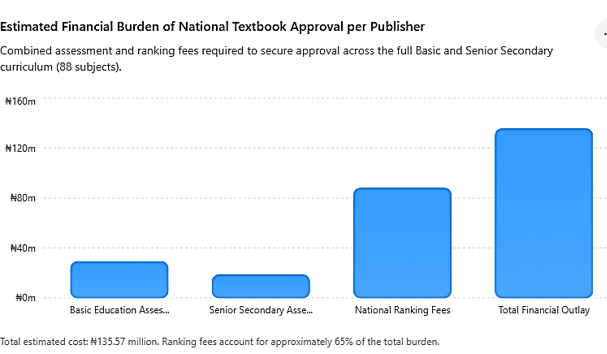
The publishers argue that this heavy financial toll, paired with an unworkable timeline, will discourage or outright bankrupt legitimate businesses. The resulting shrinkage of the local publishing sector will further decimate the volume of compliant books available on the market.
While the NPA maintains that it fully supports strict quality assurance and high educational standards, it is urging the Ministry of Education to pause the ranking exercise.
The association is calling for a realistic transition period that allows publishers to actually receive curriculum benchmarks, develop compliant texts, and manufacture them in volumes large enough to avoid a nationwide educational crisis.