

















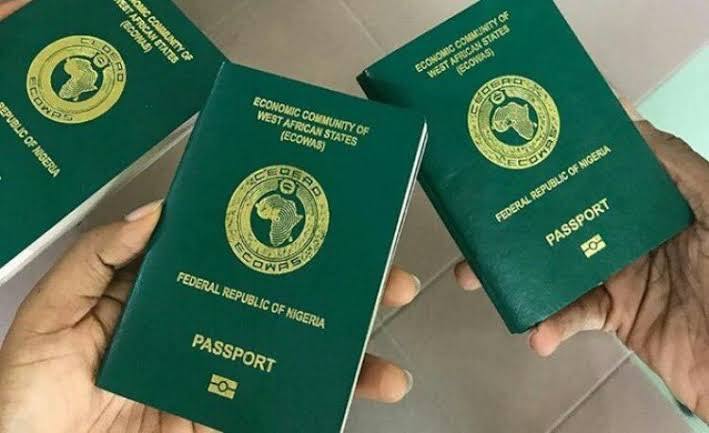
The Federal Government has defended its decision to increase the cost of Nigerian passports to N100,000 and N200,000, insisting the hike is necessary to maintain quality standards, reduce corruption, and ensure timely delivery of the travel document.
In a statement issued on Thursday by its Public Relations Officer, ACI AS Akinlabi, the Nigeria Immigration Service announced that beginning September 1, 2025, passport applications within Nigeria will cost N100,000 for the 32-page booklet with five-year validity and N200,000 for the 64-page booklet with 10-year validity.
“The review which only affect Passport Application fees made in Nigeria, now set a new fee thresholds for 32-page with five-year validity at N100,000 and 64-page with 10-year validity at N200,000,” the statement read.
The NIS, however, said Nigerians in the diaspora will continue to pay $150 for the 32-page, five-year passport and $230 for the 64-page, 10-year passport.
It explained that the adjustment was aimed at maintaining the integrity of the document while making issuance processes more efficient.
The increase comes barely a year after the Federal Government approved an earlier adjustment in August 2024, which raised the 32-page, five-year booklet from N35,000 to N50,000, and the 64-page, 10-year booklet from N70,000 to N100,000.
At the time, the NIS said the hike was necessary to sustain the quality of the passport and improve service delivery.
On Thursday, the Minister of Interior, Dr. Olubunmi Tunji-Ojo, defended the new hike.
Speaking in Abuja during the ministry’s mid-tenure performance retreat, Tunji-Ojo said the hike would ensure timely delivery of passport and eliminate corruption,
He said, “Our target is very clear: within one week of enrolment, every Nigerian should have their passport in hand. Not just delivering quickly, but delivering quality passports that reflect our integrity as a nation,” he said.
Reforms to End Delays, Extortion
Tunji-Ojo further noted that the new system was designed to eliminate long delays and extortion that once forced citizens to wait up to seven months or pay as much as N200,000 to fast-track processing.
“The system that we inherited that had six months backlog which we were able to clear in two and a half weeks. Nigerians will apply for passports and wait endlessly, or be asked to pay hundreds of thousands of naira.
“My own daughter had that bad experience. Even when I was chairman of the House Committee on NDDC, my daughter wanted passport, it was a problem. I had to pay hundreds of thousands to be able to get a passport for my daughter, a 12-year-old girl. That era is over,” Tunji-Ojo said.
The minister disclosed that the centralised personalisation centre, the largest in Africa, would ensure faster processing and tighter security.
“With this facility, we can print five times more passports than we currently need. Once you enrol, it doesn’t take us more than 24 hours to vet. Printing capacity is no longer our problem,” he explained.
As part of the reforms, Tunji-Ojo announced that Passport Control Officers will no longer have the power to approve or delay applications.
“Some PCOs had so much power that they could decide not to approve or not to print a passport until they were settled. That abuse of power ends now,” he declared.
According to him, centralising the approval process would curb corruption and restore credibility to Nigeria’s travel documents.
“We realised that the best way to cut corruption is to remove human contact to the barest minimum. Passport approval will no longer rest with PCOs. My responsibility is not for them to like me — it is to deliver efficiency. Let Nigerians be happy,” he said.
He further noted that the reforms are designed to safeguard the integrity of Nigeria’s passport, stressing that the goal is not only to make the document easily accessible but also to ensure it is issued strictly to genuine Nigerian citizens.
The minister recalled past abuses where foreigners were able to obtain Nigerian passports illegally, undermining the credibility of the country’s travel documents.
Citing an example, he mentioned the case of a Ugandan woman who was arrested at Lagos Airport after paying $1,000 to acquire a Nigerian passport, insisting that such practices must end if the passport is to remain a true symbol of national identity.