






















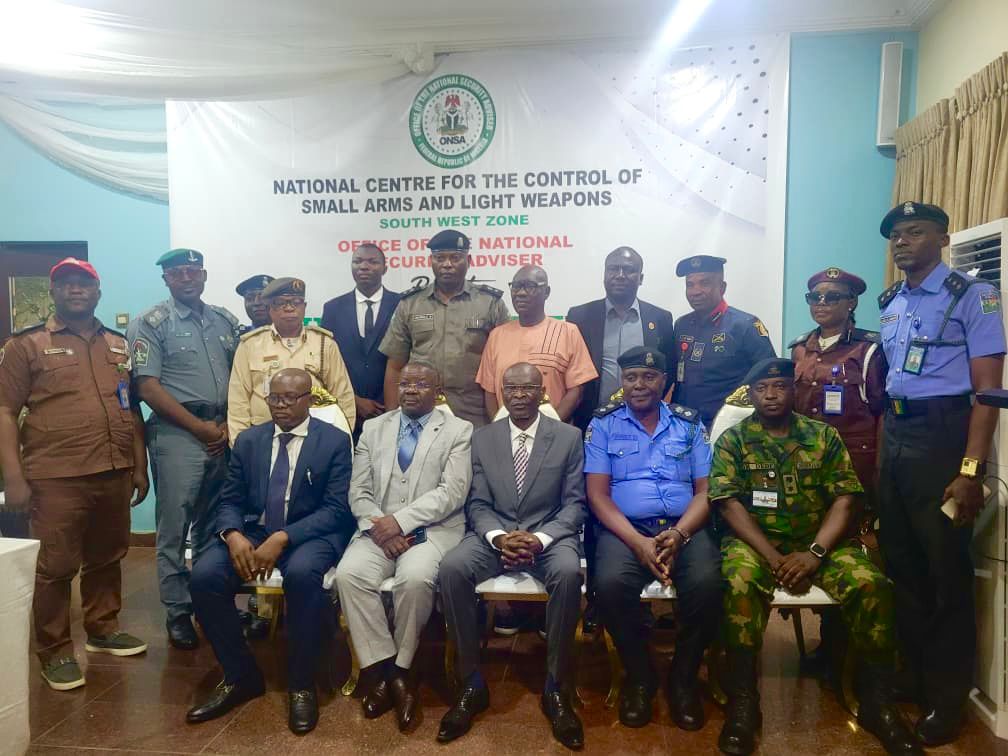
The Southwest Zonal Director of the National Centre for the Control of Small Arms and Light Weapons (NCCSALW), Abiodun Alamutu, has expressed alarm that more than five million illegal firearms are believed to be in circulation across the region, identifying the spread of small arms as a critical factor fueling insecurity in Nigeria.
Alamutu, a retired Commissioner of Police, made this known in Abeokuta, Ogun State, on Thursday at a one-day seminar organised by the agency focused on effective post-judgment handling of small arms and light weapons.
He said, “The major enabler of insecurity, banditry, terrorism in the country is the proliferation of small arms and light weapons… a large chunk of these arms are in the hands of non-state actors.”
According to him, although notable strides have been achieved in intercepting weapons at Nigeria’s borders, authorities are now redirecting efforts toward recovering arms already circulating within the country.
“The bulk of the successes we have recorded has been at the border points… But now, we want to divert our attention into mopping up those that are already in circulation,” he said.
Alamutu stressed the importance of working closely with grassroots stakeholders, including traditional institutions, community heads, and civil society organisations, to promote voluntary surrender of weapons.
The NCCSALW director reiterated that over five million illegal firearms are estimated to be in circulation within the region.
“Some claim the estimate is up to five million, but we cannot say categorically… but from records available, it falls within or quite above five million,”he said.
On regulatory matters, Alamutu noted that Nigeria is obligated under international agreements to destroy confiscated illicit arms.
“The legal framework directs that such illicit arms must be destroyed… Nigeria on its own cannot now say… we should do otherwise without going back to the law,” he stated.
He also highlighted porous borders as a persistent obstacle, despite what he described as strong political commitment.
“We have the political will… but the challenge… remains the porosity of our borders,” he said, adding that adopting modern technology would be crucial to strengthening border control.
Alamutu revealed that security agencies are still recording seizures, citing a recent interception of 43,000 live cartridges by customs which would soon be taken into custody.
Also speaking, the Ogun State Commissioner of Police, Bode Ojajuni, emphasised the necessity for improved coordination in managing recovered arms.
He said, “We have many of these arms that have been recovered… and they are in the police armories. I feel that the center should devise another avenue to mop up these weapons immediately.”
Ojajuni cautioned against prolonged delays in transferring recovered weapons, warning of possible risks.
“We are all aware that anything at times will happen to these weapons when there is too much delay,” he said.
He advocated for a coordinated framework across states to guarantee swift collection and transfer of seized weapons to the NCCSALW.
“If we can… have a unit that will coordinate the mopping up of these arms… and hand over to the center… that will create the window where we work together,” he added.
Delivering the lecture, the Head of Department of International Relations and Diplomacy, Chrisland University, Abeokuta, Dr Kunle Olawunmi, advised security agencies to reconsider destroying confiscated arms, suggesting instead that they be deployed in the fight against banditry or sold to other countries.
He further recommended that within six months, NCCSALW, the judiciary, the police, and the Federal Ministry of Justice should establish a national post-judgment SALW management framework with clearly defined roles, timelines, and documentation standards.
“Effective post-judgment management of small arms and light weapons is where law, administration, and national security meet.
“Nigeria already possesses the beginnings of an appropriate architecture.
“The urgent task now is to make that architecture operational, disciplined, and verifiable. Once adjudicated weapons are securely tracked from court order to lawful final disposition, the state closes one important route through which insecurity reproduces itself,” Olawunmi said.