











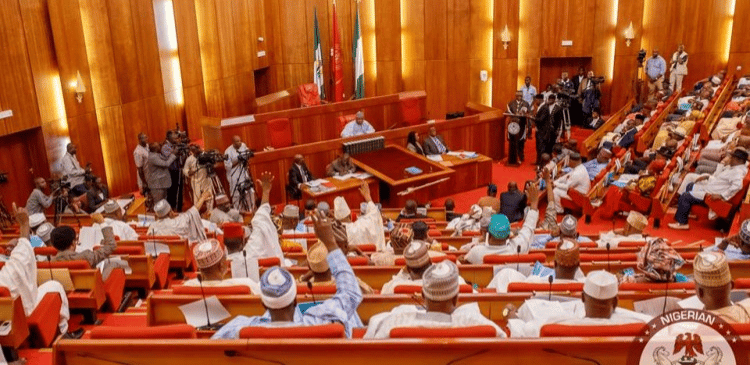
The future of Nigeria’s 2026 budget presentation has been thrown into doubt as the Senate put on hold deliberations on new fiscal proposals, demanding that the executive provide a thorough account of the 2024 and 2025 budget performances first.
This was the message delivered Thursday by the Senate Committee on Finance, which ordered senior economic officials to furnish a full report on the 2024 implementation and outlook for 2025 within two weeks.
The instruction followed a private meeting of over an hour with key government officials, including the Finance Minister and Coordinating Minister of the Economy, Mr. Wale Edun; the Accountant-General of the Federation, Mr. Samsudeen Ogunjimi; and the Director-General of the Budget Office, Mr. Tanimu Yakubu.
Committee chairman, Senator Mohammed Sani Musa (APC, Niger East), told journalists afterward that lawmakers had agreed not to move forward with the Medium-Term Expenditure Framework (MTEF) and Fiscal Strategy Paper (FSP) for 2026–2029 until the finance team delivers the documents on October 23.
“We’ve reviewed the progress made on the 2024 budget and discussed expectations for 2025,” Musa said. “But before we proceed with the MTEF and FSP for 2026, we must see clear, documented evidence of performance. The Minister of Finance has agreed to provide this report, and we will reconvene on October 23.”
Musa noted that the committee looked into the amounts released to date, warrants issued, and the approvals given to MDAs for executing capital works. He added that the panel also acknowledged President Bola Tinubu’s recent call for fresh loan approvals from the National Assembly to strengthen fiscal operations and sustain capital expenditure for 2025.
“We have made some progress, but we must do more to ensure that the 2026 fiscal cycle begins on solid ground,” the senator added.
Minister Wale Edun nevertheless insisted that the capital side of the 2024 budget was “performing well,” while the Director-General of the Budget Office offered a much darker outlook.
Mr. Yakubu called the 2024 and 2025 budget cycles “turbulent,” pointing to missed fiscal assumptions and widening shortfalls in major revenue channels.
“We have had a difficult year — one in which most of the assumptions underpinning the 2024 and 2025 budgets turned out differently from projections,” he said.
Yakubu explained that crude oil, benchmarked at $75 per barrel, had stayed $10 to $15 lower due to global price swings. He added that inflation had exceeded targets, raising debt service obligations and shrinking funds for capital spending.
He further explained that the Petroleum Industry Act (PIA) 2022 had greatly reduced inflows to the Federation Account.
“Under the PIA, 30 percent of gross oil revenue and 30 percent of oil and gas profits are retained for upstream operations, while the Federal Government shoulders NNPC’s operating costs,” Yakubu said. “This has cut allocations to the Federation Account by nearly 70 percent of previous levels.”
The Budget Office chief added that oil production targets in the MTEF have consistently been missed, intensifying cash flow strains and delaying disbursement of funds for projects.
Analysts caution that the overall impact could derail the 2026 Appropriation Bill’s presentation — threatening President Tinubu’s commitment to maintain the January-to-December budget cycle established under the last government.