















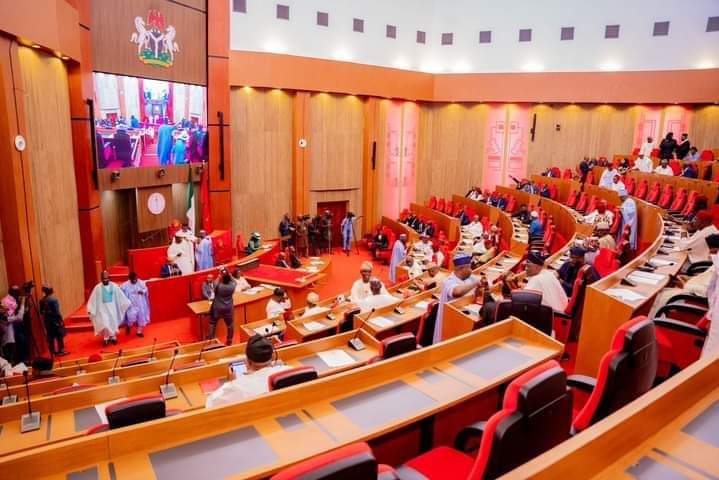
The Senate on Tuesday called on President Bola Tinubu to authorise the enlistment of 100,000 new military recruits to strengthen the fight against insurgency, banditry, and the escalating cases of school kidnappings nationwide.
Lawmakers also pressed for a comprehensive probe of the Safe School Programme, questioning the utilisation of funds allocated to the scheme despite recurring attacks on educational facilities.
Their concerns stemmed from the assault on Government Girls’ Secondary School, Maga, in Kebbi State, where armed men reportedly killed a vice principal and abducted 25 students.
The discussion followed extra prayers moved by Senator Adams Oshiomhole (Edo North) during plenary, sparking intense debate over Nigeria’s deteriorating security climate.
Senate President Godswill Akpabio led the session and later shifted the chamber into a closed-door meeting to review classified briefings.
Oshiomhole, while advocating large-scale recruitment and a full security review, cautioned that the scale of insecurity demanded a deliberate expansion of the armed forces.
He said, “I urge the President and the armed forces to recruit an additional 100,000 military personnel so we can have enough men and women in our troops. It is also another way to create employment for our youthful population.”
He also demanded explanations on the Safe School allocation.
“People have turned our security into a business. We should not monetise the death of our people by those living. What happened to the money earmarked for the Safe School Programme?”
Oshiomhole pressed further for a Senate-driven investigation and greater technological support for security agencies.
“Again, I urge the FG and the relevant Senate committees to probe the funds appropriated for the Safe School Programme.
“I call on the military to deploy the use of technology and tracking devices to be able to track these criminals,” he urged.
His supplementary prayer was unanimously supported and adopted by lawmakers from different parties.
Responding, Senate President Godswill Akpabio backed the call for 100,000 additional troops and approved scrutiny of the Safe School Programme.
“We urge the Federal Government and the Senate committee to probe the spending. Unfortunately, these criminals are going after soft targets.”
Akpabio further cautioned lawmakers against using insecurity for political advantage and extended sympathy to victims of the Maga school attack.
“But crime is crime. It doesn’t matter under which administration it takes place. Even the almighty America has crime daily.
“All lives matter. May the souls of our fellow Nigerians and the vice principal who died in the course of protecting the students rest in peace.”
Despite adopting the Safe Schools Declaration in 2015, Nigeria has continued to witness a decade-long cycle of assaults on educational institutions.
The initiative, endorsed by the Federal Government, outlines steps intended to safeguard learning spaces during armed conflict.
UNICEF has consistently urged Nigeria to fully enforce the declaration, emphasising the urgency of safe and protective learning environments.
Gunmen had earlier invaded Maga Comprehensive Girls’ Secondary School in the early hours of Monday, killing a vice principal and kidnapping multiple students.
A school guard sustained injuries during the incident. Security agencies, including the Nigeria Police Force and the military, have since commenced a search-and-rescue mission.
The Senate debate also reflected on the nation’s current military strength and defence preparedness.
According to Global Firepower’s 2022 ranking, Nigeria maintained its 35th position out of 142 countries and is rated as Africa’s third most capable military.
The report lists Nigeria’s active personnel at 135,000, total military strength at 215,000, and notes the absence of a reserve force.
It further details Nigeria’s defence assets: 140 aircraft, 376 tanks, 2,019 armoured vehicles, 349 towed artillery units and 47 rocket projectors, among other equipment.
Despite these figures, senators argued that the gulf between military capability and operational demands remains significant, reinforcing the appeal for new recruitment and stronger protection of schools in vulnerable regions.