











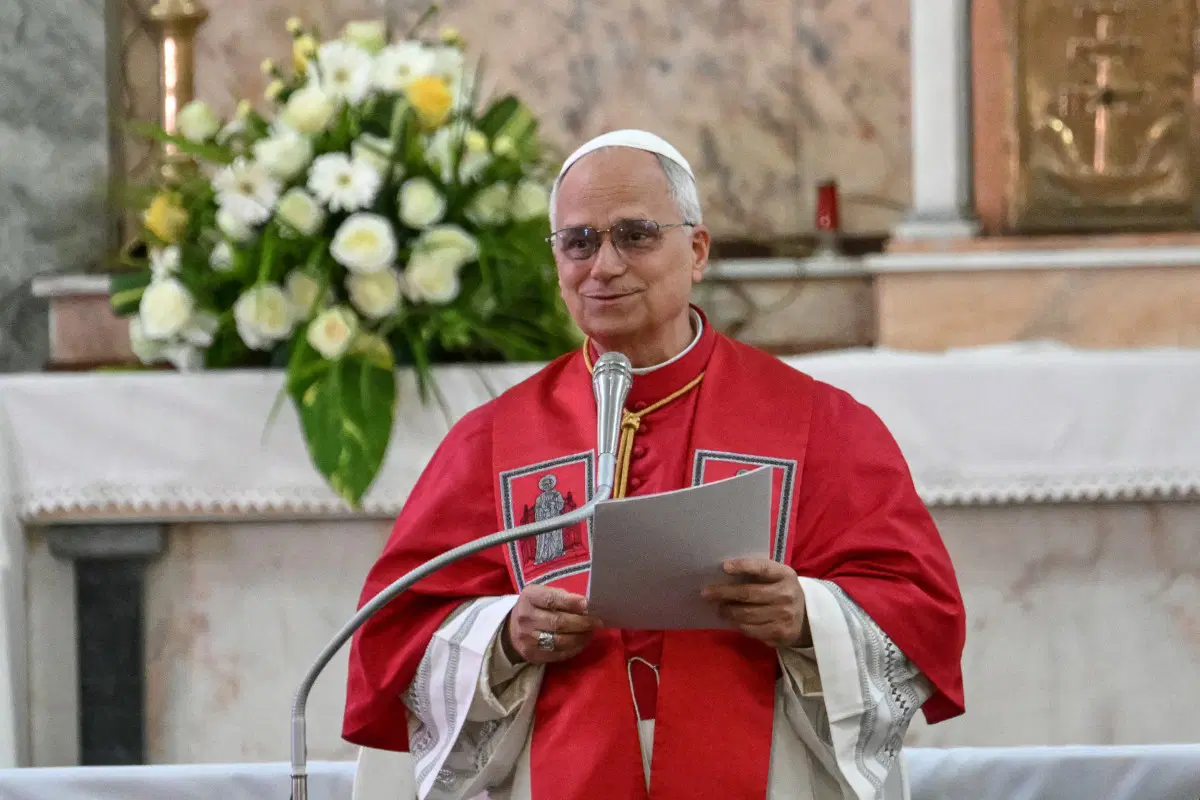
Pope Leo XIV departed on Tuesday for the concluding leg of his African tour in Equatorial Guinea, where, according to media reports, his increasingly outspoken advocacy for human rights will be closely observed in one of the continent’s most restricted nations.
After departing Angola in the morning following a three-day visit, the US-born pontiff is expected around noon (1100 GMT) in the Central African country, ruled since 1979 by Teodoro Obiang Nguema Mbasogo, 83, the world’s longest-serving non-monarch head of state.
Leo retraces the path of John Paul II, who four decades ago became the first pope to visit Equatorial Guinea, an oil-rich nation of about two million people, 80 percent of whom are Catholic, a legacy of Spanish colonial rule.
Throughout his African journey, the pope has denounced oppression and exploitation while advocating peace and social justice, shifting from his previously reserved tone to a more assertive stance.
Human rights concerns in focus
Attention now turns to whether that pattern will persist in Equatorial Guinea, where he will be received by a government frequently criticised for authoritarian governance and human rights violations.
Ads by Much of the country’s opposition leaders and independent media, often harassed by authorities, now live in exile in Spain.
“The pope is coming for the country’s leaders. His visit won’t do anything for us, because he’s not coming to persuade the ruling class to take our suffering and grievances into account at the expense of their own enrichment with the country’s resources,” said Anita Oye, a tomato seller in the former capital Malabo.
Despite having one of Africa’s highest per capita incomes, most citizens remain impoverished, largely due to oil wealth distribution.
Equatorial Guinea’s government is frequently criticised by international NGOs for widespread corruption and suppression of dissent, including arbitrary arrests and restrictions on civil liberties.
Mixed reactions from citizens and opposition
In Malabo, situated on Bioko island in the Gulf of Guinea, large images of the pope and welcome banners adorn the streets, alongside flags of the Vatican and Equatorial Guinea.
A hymn composed in his honour will be performed by church choirs nationwide during his stay.
Malabo resident Juan Raul told AFP he believes the visit could unite the country.
“This will bring spiritual change and motivate many people to go to mass,” he said.
However, some worry that citizens will bear the financial burden of the pope’s visit, including Andres Esono Ondo, leader of the country’s only authorised opposition party, the Convergence for Social Democracy.
Ondo expressed concern that the trip could deepen hardship among citizens forced to shoulder “the economic damage”, which he assumed was “something the pope does not wish for”.
Leo is scheduled to speak on Tuesday before the president, government officials, the diplomatic corps, civil society members, and representatives from the cultural sector.
On Wednesday, he will travel to Obiang’s stronghold of Mongomo to celebrate mass and meet students and teachers at a technology institute named after Pope Francis.
He will then proceed to the economic hub Bata to honour victims of a 2021 explosion that killed over 108 people at a military camp and also visit inmates at Bata prison.
On Thursday, the pontiff will celebrate a major mass at Malabo stadium before concluding his intense 11-day, 18,000-kilometre (11,200-mile) African tour.