




















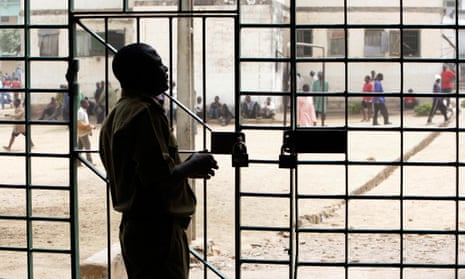
The Federal Government has earmarked more than N49bn in the 2026 budget proposal for inmate feeding, healthcare supplies, custodial facility rehabilitation, uniforms, and the acquisition of arms and security hardware.
A breakdown of the allocation showed that N40bn was set aside for food items and catering materials, N1bn for uniforms and clothing materials, N1bn for medicines and medical consumables, N5bn for the rehabilitation and repair of prison infrastructure, and N861m for correctional biometrics, arms, ammunition, and other security assets.
Statistics from the Nigerian Correctional Service website show that the total number of inmates in custodial centres nationwide stands at 77,438, with 50,357 currently awaiting trial.
Reports and official data also indicate that thousands of inmates, including several charged with grave offences such as terrorism and armed robbery, escaped from 13 correctional facilities between 2019 and 2025.
In February 2025, the Minister of Interior, Olubunmi Tunji-Ojo, revealed that President Bola Tinubu had approved the relocation of 29 correctional centres nationwide as part of moves to modernise the custodial system.
The minister explained that many existing facilities, including those located in Suleja and Ikoyi, were constructed in the 1950s and no longer align with modern standards.
Tunji-Ojo stated that the relocation and modernisation initiatives are intended to enhance conditions for correctional personnel and inmates, resolve persistent infrastructural problems, and establish a more efficient and rehabilitative correctional framework.
The minister stressed that the existing facilities are unsuitable for contemporary correctional operations and that infrastructural upgrades are essential to improving security and rehabilitation outcomes nationwide.
In December, the Controller General of NCoS, Sylvester Nwakuche, urged the National Health Insurance Authority to extend its health insurance scheme to inmates.
Nwakuche said the move is designed to address persistent healthcare challenges in custodial centres and prevent avoidable inmate deaths.
He added that, as a confined and underserved population, inmates deserve access to quality healthcare, just like other citizens of the country.