

















The Federal Government has announced the opening of applications for admission into Federal Technical Colleges nationwide, reaffirming its dedication to free technical education, skills acquisition and youth empowerment.
The announcement was issued by the Federal Ministry of Education following the endorsement of the programme by the Minister of Education, Dr Maruf Tunji Alausa.
In a statement signed by the Director of Press and Public Relations, Boriowo Folasade, the ministry said the initiative aligns with the government’s wider strategy to broaden access to quality technical and vocational education while equipping young Nigerians with practical, employable and industry-relevant skills.
The statement read: “Registration for the National Common Entrance Examination (NCEE) into Federal Technical Colleges will open on Monday, 26th January 2026, and close on Sunday, 24th May 2026. The entrance examination will be conducted nationwide on Saturday, 6th June 2026.”
It added that applications must be completed through the National Business and Technical Examinations Board (NABTEB) portal, stressing that “possession of a valid National Identification Number (NIN) is compulsory for all applicants.”
The ministry further reiterated that “technical education in Federal Technical Colleges is fully funded upon admission,” noting that the programme underscores the government’s commitment to “human capital development, youth empowerment, and enhanced national productivity.” Admission is open to candidates aged between 13 and 20 years.
In a related development, the Federal Government has inaugurated a Book Ranking and Selection Committee aimed at improving the quality and affordability of textbooks used in Nigerian schools.
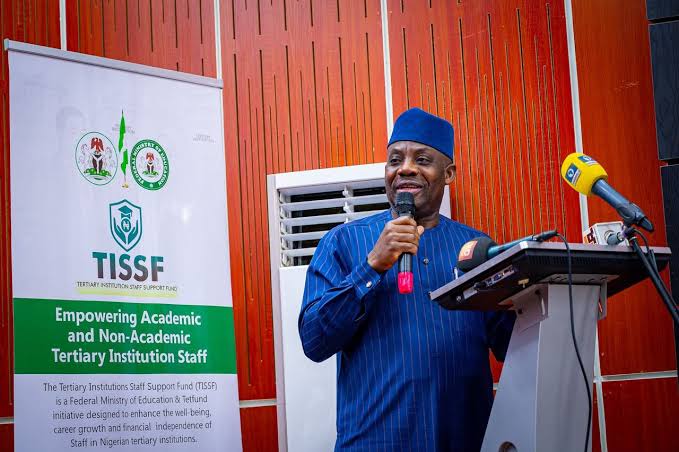
Speaking at the inauguration in Abuja, Dr Alausa said the existing textbook approval system failed to properly validate and rank learning materials, resulting in some subjects having up to 50 approved books without clear quality benchmarks. He said this allowed low-quality materials to coexist with better instructional resources.
The minister also criticised the practice of bundling workbooks with core textbooks, saying it forced parents to buy new books yearly and created unnecessary financial pressure. According to him, the committee’s mandate is to introduce reforms that ensure quality, transparency and fairness.
“Your assignment is both timely and strategic,” Alausa said. “You are expected to critically review existing approval frameworks, recommend strengthened assessment instruments and ranking systems, define clear and enforceable quality benchmarks, and propose mechanisms that ensure genuine content improvement before new editions are approved.”
He added that while many books could be approved, “only seven textbooks per subject would be officially ranked for selection by schools,” adding that once ranked, textbooks would remain in use for a minimum of three years.
Chairperson of the committee and Minister of State for Education, Prof. Suwaiba Ahmad, pledged the panel’s commitment, noting: “As long as a textbook meets the minimum standard, it is approved, without any benchmark to determine whether it is of grade A, B or C quality.”
Also speaking, the NERDC Executive Secretary, Prof. Salisu Shehu, said the reform would end arbitrary book selection and ensure that only high-quality instructional materials are adopted nationwide.