






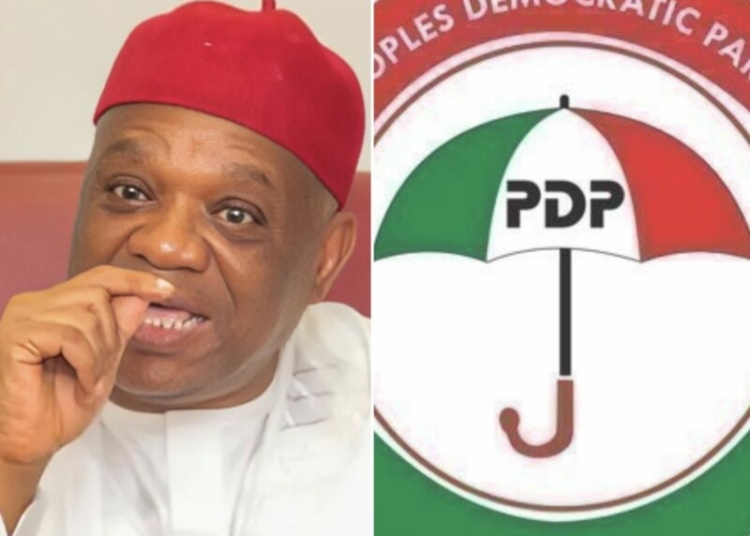




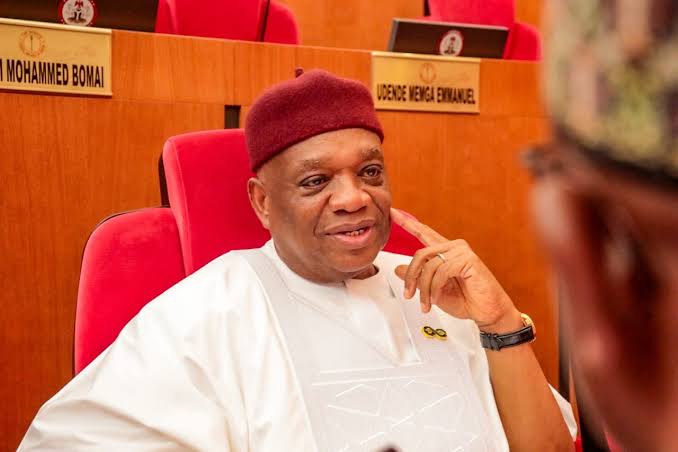
Senator representing Abia North, Orji Uzor Kalu, has admitted that he was previously involved in the international arms trade, disclosing that he sold weapons to anyone who could afford them, regardless of their political affiliation or intended use.
Kalu said he abandoned the business only after his parents, particularly his mother and father, intervened and insisted that he stop dealing in weapons.
The former Abia State governor made the revelation during an interview on Arise Television’s *Prime Time* programme on Monday, November 9, 2026, while discussing his longstanding relationships with former and current South African leaders.
During the interview, Kalu openly acknowledged being an arms dealer, explaining that his former business interests extended beyond Nigeria and involved the international movement and sale of heavy weapons between countries.
When the interviewer directly asked whether he was an arms dealer, Kalu answered in the affirmative but explained that he eventually abandoned the business following pressure from his parents.
He said, “But my parents, my mother, my father came and said I must stop, and I stopped.”
The senator, however, sparked further attention when the interviewer questioned whether he sold weapons to individuals who intended to use them to kill other people.
Dismissing the suggestion that he was concerned about how the weapons were used, Kalu said his primary motivation was to make money.
“No, no, no, no, no, no. I was selling guns to make money, whether they blow up it’s not my business,” he said.
The interviewer subsequently asked whether Kalu supplied weapons to the African National Congress (ANC) during its struggle against apartheid in South Africa.
However, the senator said he was not selling exclusively to the ANC, insisting that his business was open to any interested buyer who had the financial means to purchase weapons.
“No, I was selling to anybody who wants to buy. If you have the money, you want to buy in D.R.C, I sell to you, you want to buy in Namibia, you want to buy…” he said.
When pressed to disclose where he obtained the weapons, Kalu declined to provide details, describing the information as private to his business.
Asked about the source of the weapons, he responded, “It’s only my business.”
The conversation also turned to Nigeria’s persistent insecurity and the proliferation of small arms and light weapons, with the interviewer questioning how Kalu’s account of his former business related to the circulation of illegal firearms across the country.
However, the senator insisted that the weapons he traded were not small arms, explaining that his business involved heavy weapons transferred between countries.
“No, no, these are heavy arms that were sold country to country,” he said.
In another striking moment during the interview, the interviewer specifically questioned Kalu about whether he sold weapons to Libya under its former leader, the late Colonel Muammar Gaddafi.
Rather than confirming or denying a specific transaction, Kalu maintained that he sold to anyone who had the money to purchase the weapons.
“To anybody that had money to buy,” he responded.
When the interviewer suggested that his answer meant he had also sold weapons to Gaddafi, Kalu reacted by expressing admiration for the late Libyan leader.
“May his soul rest in peace. He was a good man. If you have money to buy, when I was selling, I would sell to you,” he said.
Although Kalu’s response did not provide specific confirmation of an arms transaction with Gaddafi, his remarks reinforced his position that he was willing to sell weapons to any financially capable buyer.
Beyond his disclosure about arms trading, Kalu also used the interview to discuss his longstanding relationships with prominent South African political figures, tracing his connections to the late former President Nelson Mandela.
According to the senator, his relationship with South African political leaders began through his friendship with Mandela, who introduced him to several leading figures in the country, including former President Thabo Mbeki and current President Cyril Ramaphosa.
Kalu recounted that Mandela once explained to him that Mbeki’s father had contributed more to the anti-apartheid struggle than Ramaphosa’s father.
According to Kalu’s account, the explanation formed part of the considerations behind the African National Congress’s decision to favour Mbeki over Ramaphosa for a leadership position alongside Mandela.
He further disclosed that Mbeki later introduced him to former South African President Jacob Zuma, adding that his relationships with the country’s successive administrations continued over the years.