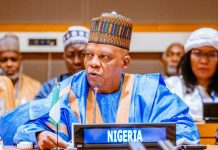










Borno State Governor, Professor Babagana Umara Zulum, has urged the Nigerian Air Force to scale up the deployment of Unmanned Aerial Vehicles (UAVs) in the North East, insisting that technology must drive future counterinsurgency operations.
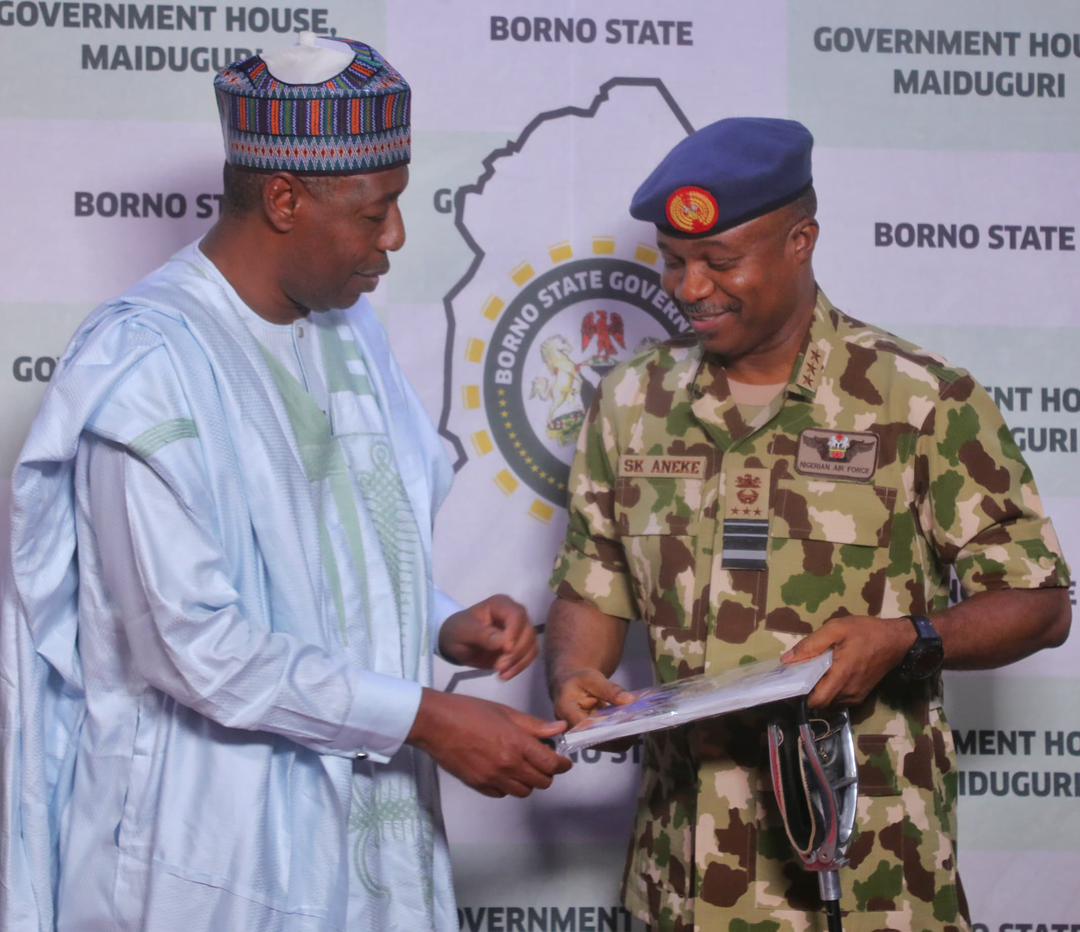
Governor Zulum made the call on Monday when he received the Chief of the Air Staff, Air Vice-Marshal Sunday Kelvin Aneke, who arrived in Maiduguri for his maiden operational visit.
AVM Aneke earlier landed at the Maiduguri Air Force Base, where he was received by senior military commanders before proceeding to the Government House for a strategic security briefing.
Zulum said the conflict has reached a stage where technology must take the lead, particularly in surveillance, early warning, and precise targeting of insurgent movements.
He stressed that UAVs remain the most effective asset for tracking activities in insurgent hideouts and for providing real-time intelligence to ground forces.
He identified the Lake Chad islands, known as the Tumbus, as a major safe haven for Boko Haram and ISWAP fighters, adding that a technology-supported, joint operation involving the Army, Navy, and Air Force is urgently needed.
“A thorough military operation involving the Naval, Air Force, and Army, purposely intended to rid off the Tumbus, has never been conducted,” Zulum said.
He noted that such an operation is essential for lasting security.
He also highlighted the Sambisa Game Reserve and the Mandara Hills as remaining insurgent enclaves requiring improved aerial surveillance and coordinated strikes.
Zulum recommended that military command-and-control structures hold a strategic planning session in Maiduguri to strengthen cooperation and refine operational tactics.
He commended President Bola Ahmed Tinubu for the support extended to the armed forces but emphasized the need for more investments in modern air platforms and advanced surveillance systems.
Earlier, the Chief of the Air Staff praised the governor’s “Borno Model” for helping stabilize communities and enabling military operations through reconstruction, reconciliation, and logistical support.
“The ‘Borno Model’ has prioritized healing, reintegration, and local ownership, and it continues to complement military efforts toward sustainable results,” Aneke said.
He added that the Nigerian Air Force under his leadership will focus on “operational readiness, integration with ground forces, and the intelligent application of airpower” to support counterinsurgency operations.