



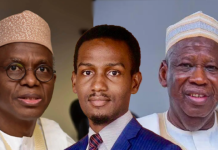



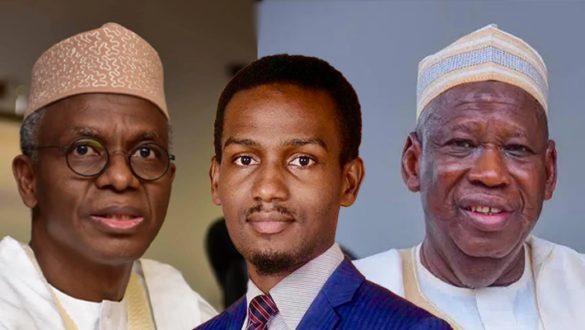
Former Governor of Kano State, Abdullahi Umar Ganduje, has categorically dismissed allegations by his former Kaduna State counterpart, Nasir El-Rufai, linking him to the disappearance of Abubakar Idris, widely known as Dadiyata.
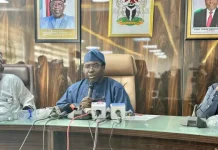
According to media reports, in a calm but direct response contained in a statement signed by former Commissioner for Information and Internal Affairs in Kano State, Comrade Muhammad Garba, the former APC national chairman described the allegation as reckless, baseless and a clear effort to divert responsibility for an incident that occurred entirely within Kaduna State.
He stressed that Dadiyata lived and worked in Kaduna, where he was widely known for directing his criticisms at the Kaduna State government.
According to him, there is no credible record indicating that the activist’s primary focus was the Kano State government or Dr. Ganduje.
“Everyone in Kaduna knew the nature of the criticism he made and who it was directed at,” he stated, adding that responsibility for security in Kaduna at the time rested with the state government and the relevant federal security agencies operating there.
The statement called for careful scrutiny of El-Rufai’s recent remarks, stressing that such serious allegations must be supported by verifiable evidence rather than political rhetoric.
Dragging Ganduje into the matter without proof, Garba said, not only politicizes a painful and unresolved episode but also risks further misleading the public over an already sensitive case.
Contrasting the political climates of both states during the period in question, Garba maintained that Ganduje’s two-term administration in Kano was marked by tolerance for criticism, open media engagement and acceptance of opposition voices.
“Unlike many political leaders who maintained strained relationships with the media, we allowed scrutiny, accommodated critical voices and even learned from dissenting perspectives,” he said.
The former Commissioner added that there was no record of arrests, intimidation or harassment of journalists or critics in Kano during Ganduje’s tenure.
He further observed that public discourse surrounding Dadiyata’s disappearance has, over the years, centered largely on events within Kaduna State.
He noted further that former Senator Shehu Sani had openly remarked that many individuals within the state were reluctant to speak publicly about the case, while commentator Reno Omokri previously raised allegations questioning how the matter was handled at the time.
Garba also expressed concern over El-Rufai’s claim that a police officer allegedly confessed to being sent from Kano to abduct Dadiyata.
He questioned why such grave information, if credible, was not formally disclosed to investigative authorities or pursued transparently through appropriate security channels at the time.
“It is difficult to reconcile a claim of having no prior knowledge of the individual with simultaneously making detailed assertions about who was responsible,” he noted.
While reiterating sympathy for Dadiyata’s family, Garba stressed that the priority should remain on uncovering the truth through lawful and transparent investigative processes.
“The family deserves closure,” he said. “What they do not deserve is for this tragic matter to become an instrument of political blame-shifting.”
He concluded by urging anyone with credible information regarding the abduction to present it to the appropriate authorities, emphasizing that accountability must rest on facts and due process, not speculation.