






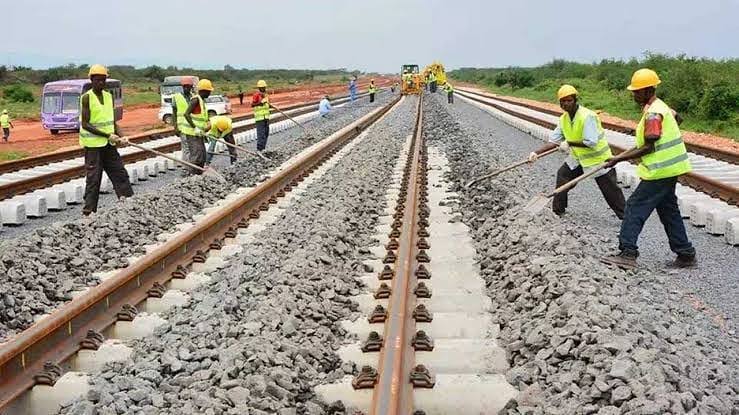
Minister of Transportation, Sa’idu Ahmed Alkali, has disclosed that the Kano–Maradi standard gauge rail line will extend to Katsina by December 2025, with full completion projected for March 2027.
Speaking at the second Transport Summit of the Transportation Correspondents Association of Nigeria (TCAN) in Lagos on Tuesday, Alkali represented by the Managing Director of the Nigerian Railway Corporation (NRC), Dr. Kayode Opeifa explained that construction on the Kaduna–Kano and Kano–Maradi lines has advanced from just 5 and 15 percent completion at the start of the current administration to more than 50 and 60 percent, respectively.
The Guardian NG reported that “he also disclosed that the Federal Executive Council recently approved the construction of modern bus terminals in Abeokuta, Onitsha, Warri, Kano, Lokoja, and Gombe.”
According to him, the initiative aims to address operational inefficiencies, ease intra-city traffic, phase out unregulated motor parks, and improve passenger safety nationwide.
Highlighting broader efforts, Alkali noted the Lagos–Kano rail modernization, the refurbished narrow-gauge line from Lagos to Kano, and the ongoing rehabilitation of the Port Harcourt–Maiduguri corridor as evidence of government commitment to transforming Nigeria’s transport sector. He confirmed that the Port Harcourt–Aba section of the Port Harcourt–Maiduguri line has already been completed and is now operational.
Meanwhile, Minister of Marine and Blue Economy, Adegboyega Oyetola represented by Director of Maritime Services, Dr. Mercy Iloro stressed that the National Marine and Blue Economy Policy is designed to lower logistics costs, improve trade competitiveness, and attract private investment.
“Our goal is to lower the cost of doing business, improve cargo turnaround times, and create a more attractive environment for private capital. This positions Nigeria as a logistics hub for West and Central Africa,” Iloro said.
She highlighted ongoing projects such as the operationalisation of the Lagos–Ibadan standard gauge for cargo evacuation, expansion of barge services at Lagos and Onne ports, completion of the Apapa–Oshodi Expressway, and commissioning of the 27km Lekki Port Access Road.
She also mentioned the development of inland dry ports in Ibadan, Kaduna, Kano, and Funtua to ease seaport congestion and strengthen regional trade.
Oyetola urged greater collaboration among stakeholders shipping lines, terminal operators, freight forwarders, and regulators while advocating digital, green, and climate-resilient logistics solutions to enhance Nigeria’s competitiveness.
Earlier, TCAN Chairman Tola Adenubi lamented the absence of a comprehensive national transport policy, warning that overreliance on road transport, especially by petroleum tankers and container trucks has left many roads in disrepair. He stressed the urgent need to diversify freight movement to rail, waterways, and pipelines.